
Call us today
01202 986262
Commercial solar can offer a convincing route towards lower electricity costs, greater energy independence and improved environmental performance. Nevertheless, the initial investment can be difficult to justify when a business must also fund equipment, recruitment, stock, property improvements and future growth.
Fortunately, purchasing a solar PV system outright is not the only option. Depending on the business, its premises and its financial position, commercial solar may be funded through a power purchase agreement, asset finance, leasing or another suitable arrangement.
Each option has different implications for ownership, monthly expenditure, maintenance and long term value. A careful comparison is therefore essential before any agreement is made.
Save Energy UK helps businesses across Dorset and the South Coast assess their premises, understand their energy use and explore a suitably designed commercial solar installation.
A business may be able to install commercial solar without committing a substantial amount of capital at the beginning of the project. The most suitable route will depend on several factors, including its electricity consumption, credit position, roof condition, property arrangements and plans for the future.
However, commercial solar without upfront capital does not mean free solar power. The cost of the equipment and installation must still be recovered through electricity purchases, finance repayments, lease payments or another commercial structure.
Decision makers should look beyond the absence of an initial payment. The total cost of the arrangement, the length of the commitment and the eventual ownership of the equipment are equally important.
Businesses can generally consider several possible approaches to funding a solar installation. Not every arrangement will be available to every organisation, and the precise terms will depend on the provider.
A solar power purchase agreement, commonly known as a PPA, can allow a business to benefit from solar electricity without buying the system at the outset.
Under a typical on site arrangement, a third party funds and arranges the installation of solar panels at the commercial property. The business then purchases the electricity generated by the panels at a rate established within the agreement.
The Government defines a power purchase agreement as a long term electricity purchase agreement between a generator and a buyer. It also recognises on site arrangements where solar panels are installed at the property of the business using the electricity.
The provider will usually retain ownership of the system during the agreement. It may also assume responsibility for specified maintenance and performance obligations. However, this must be established in the contract rather than assumed.
A PPA may appeal to organisations that want to preserve capital while gaining access to renewable electricity. It can also provide a clearer basis for forecasting part of the organisation’s energy expenditure, although future pricing will depend on the terms of the agreement.
Businesses considering this route can read Save Energy UK’s complete guide to commercial solar power purchase agreements.
Commercial solar finance allows a business to spread the cost of an installation over an agreed period rather than paying the full amount immediately.
Regular repayments may make the project easier to incorporate into the organisation’s cash flow. Depending on the agreement, the business may own the equipment from the beginning or acquire ownership after completing the payments.
The important figure is not merely the monthly repayment. Directors should compare the total amount payable with the expected value of the electricity generated. They should also examine interest, fees, repayment periods, early settlement terms and the consequences of missed payments.
Save Energy UK offers finance options subject to status and affordability. The company acts as a credit broker rather than a lender, and businesses remain free to seek finance independently.
Asset finance is often considered by organisations that want to spread the cost while retaining a route towards ownership.
The solar installation is treated as a business asset, with payments made over an agreed period. The precise structure can vary, so the business should establish who legally owns the equipment during the agreement and whether ownership transfers at its conclusion.
This route may allow a business to preserve more working capital while retaining a greater share of the system’s long term value than it might receive through a PPA. However, repayments remain a financial commitment and must be considered alongside existing borrowing and future investment plans.
Appropriate accounting and tax advice should be obtained before proceeding. The treatment of the equipment and payments will depend on the structure of the agreement and the circumstances of the business.
A lease can allow a business to use a commercial solar system in return for regular payments. The leasing company will normally retain legal ownership during the agreed term.
Leasing may reduce the initial financial burden, but the contract requires careful examination. The business should determine who maintains the system, who benefits from exported electricity, whether payments can increase and what happens when the lease ends.
A lease may offer the option to purchase the equipment, extend the arrangement or return it. These provisions vary considerably, so they should be confirmed before the business makes a commitment.
Buying a commercial solar system outright requires the greatest initial expenditure, but it can also provide the greatest degree of control.
The business owns the equipment and receives the full value of the electricity it generates, subject to maintenance and operating costs. It can also make decisions about future alterations, battery storage and the use of exported electricity without relying on the consent of a finance or PPA provider.
For a business with sufficient capital, outright ownership may deliver stronger long term savings than an arrangement in which another party must recover its investment.
The decision should therefore consider more than the immediate effect on cash flow. A PPA may suit an organisation that wants to protect its reserves. Finance may suit a business that prefers eventual ownership. An outright purchase may appeal to an organisation seeking maximum control and lifetime value.
Commercial solar funding is not approved solely because a building has a large roof. Providers must be satisfied that the installation and the financial arrangement are commercially viable.
Businesses with consistent daytime electricity consumption are often well placed to use a substantial proportion of the power as it is generated. Manufacturers, warehouses, offices, hotels, schools, care facilities, leisure venues and agricultural enterprises may all have suitable consumption patterns.
A provider is also likely to consider the financial strength of the organisation. Government evidence identifies credit requirements, contractual complexity and long term commitments as barriers within the corporate PPA market.
The assessment may consider:
A business with uncertain property plans or limited daytime demand may find that another energy strategy is more appropriate.
Commercial solar finance and PPAs can create commitments lasting several years. The contract should therefore explain exactly what the business will pay, what it will receive and what happens if its circumstances change.
Directors should establish how payments or electricity prices are calculated and whether they can rise. They should also ask who receives any export income, who pays for repairs and what performance standards apply.
Property matters are equally important. A tenant will normally require the consent of its landlord. The agreement should explain what happens if the lease expires, the business moves or the property is sold.
With a PPA, the business should understand what happens to the panels when the contract ends. Depending on the agreement, the system may be transferred, retained, replaced or removed. Any associated cost should be clear from the beginning.
Independent legal, financial and tax advice can help a business understand these obligations before signing.

Funding can make commercial solar more accessible, but it cannot compensate for an unsuitable design.
The proposed system should reflect the electricity consumption of the business rather than simply cover every available section of roof. A system that generates considerably more electricity than the premises can use may produce a weaker financial outcome unless there is a suitable plan for export or storage.
A professional assessment should examine recent electricity bills and, where available, half hourly consumption data. This reveals when the business uses electricity and how closely that demand corresponds with expected solar generation.
The survey should also consider the roof, shading, structural condition, electrical infrastructure and safe access. These findings allow the installer to prepare realistic projections rather than relying on broad assumptions.
Save Energy UK has more than twenty one years of experience and reports more than 5,000 completed installations. The company is MCS certified and CHAS Elite accredited, with an in house team providing bespoke design, installation, handover and aftercare.
Its commercial solar case studies demonstrate why every system requires an individual design.
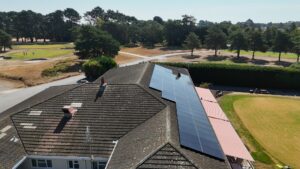
At Knighton Heath Golf Club, Save Energy UK installed a 30kW solar PV system comprising 75 panels. The system is expected to generate approximately 26,963 kWh each year, with estimated electricity savings of £6,149 during the first year. These projections relate to that particular property and should not be treated as a general promise of performance.
The project illustrates the value of designing a system around the available space and the electricity requirements of the organisation.
A commercial solar project should begin with a conversation about the property, electricity use and commercial objectives.
Save Energy UK can then prepare a bespoke system proposal and complete a detailed technical survey. This allows the design to be checked against the physical and electrical requirements of the site.
Once the design, quotation and chosen funding arrangements have been approved, the installation can be scheduled around the needs of the business. Following commissioning, the team provides a system handover and continuing aftercare.
This structured process helps the business understand what is being installed, how the system is expected to perform and what responsibilities will remain after completion.
No. An arrangement may remove or reduce the initial payment, but the equipment and installation still have to be funded. The cost may be recovered through finance repayments, lease payments or the purchase of electricity under a PPA.
Neither option is automatically better. A PPA may suit a business that wants to use solar electricity without owning the system initially. Finance may be more appropriate for an organisation that wants to spread the cost while retaining a route towards ownership.
Potentially, but the landlord’s written consent is likely to be required. The remaining lease term must also be compatible with the proposed finance or PPA agreement.
Battery storage may be suitable where it improves the use of solar generation or supports a particular operational requirement. Its inclusion will depend on the system design, energy profile and chosen funding arrangement.
The first step is to gather recent electricity bills and information about the premises. Save Energy UK can then assess the site, discuss the available options and prepare a proposal based on the needs of the organisation.
Commercial solar without upfront capital may be achievable, but the correct route depends on the business, the property and the proposed system.
A carefully designed installation should support the organisation’s electricity consumption, financial priorities and long term plans. Funding should then be selected on the strength of its complete terms rather than the attraction of a low initial payment alone.
Save Energy UK designs and installs bespoke commercial solar systems for businesses across Dorset and the South Coast. To explore the available options, contact our commercial solar team and arrange a free survey and tailored quotation.