
Call us today
01202 986262
For many businesses, solar panels and battery storage can work well as a single energy system. Panels generate electricity during daylight, while a battery stores some of the surplus for use later. This can help a business use more of its own solar power instead of exporting it to the grid.
However, installing both technologies is not automatically the right choice for every site. The value of a battery depends on when your business uses electricity, how much solar energy the panels produce and the cost of storing it. A carefully designed system should reflect your actual energy use, rather than simply adding the largest battery available.
For businesses in Dorset and across the South Coast, Save Energy UK can assess the site, review its energy requirements and design a commercial solar system around its needs. The first step is to understand what panels and battery storage could do for your business.
Solar panels produce electricity when daylight reaches their cells. Your business can use this power as it is generated. If the panels produce more electricity than the premises need at that moment, the surplus can charge a connected battery.
The battery can then supply stored electricity when solar generation falls, such as during the evening or on a dull day. If the battery is empty, the business can draw electricity from the grid as usual. If it is full and the panels continue to generate more than the business can use, the remaining electricity may be exported, subject to the system and export arrangements.
Using solar electricity directly is usually the simplest way to benefit from a system. A battery can shift some of the available energy to a later time, but storing and using electricity involves some energy loss. The battery also adds to the installation cost. These factors make it important to assess whether the extra self consumption is likely to justify the additional investment. Energy Saving Trust
A battery may help a business use solar electricity outside the hours of strongest generation. This can be useful where operations continue into the evening, equipment runs overnight or the business has a lower daytime demand than its solar panels can supply.
The benefit depends on the site. A business that already uses most of its solar generation during the day may have less surplus electricity for a battery to store. A business that exports a significant amount during sunny periods may have more reason to consider storage.
A solar and battery system can give a business more control over when it uses electricity from the grid. Depending on the system design, energy tariff and operating schedule, stored electricity may help reduce the amount imported during certain periods.
This does not guarantee lower bills in every case. Results depend on the system’s size, the electricity a business consumes, its import and export rates, and how the battery is managed. A realistic assessment should show the assumptions behind any savings estimate.
Commercial solar can form part of a broader plan to reduce grid consumption and emissions. It may also support future projects such as electric vehicle charging or the electrification of some business equipment. These plans need to be considered when the system is designed, since they can affect the required generation, battery capacity and electrical infrastructure.
A battery can also provide backup power in some system configurations. This should be discussed explicitly with the installer. Standard grid connected systems may shut down during a power cut for safety, so battery storage alone does not necessarily mean your premises will remain powered during an outage.
The strongest case for a combined system often arises where a business has substantial electricity use, a suitable roof or site, and periods when its demand does not match solar generation.
Warehouses, workshops, hospitality venues, schools, farms and leisure facilities may have useful areas for panels and significant electricity needs. Yet the type of business alone does not determine whether a battery is worthwhile. Two organisations in the same sector can have very different operating hours, equipment and energy profiles.
A review of half hourly electricity data can help show when a site imports and exports power. The assessment should consider:
The battery should be sized to suit the business’s likely surplus and later demand. An oversized battery may add cost without being used fully. A small battery may fill quickly and leave more solar power available for export. A site assessment can help establish a practical balance.
A business may not need battery storage if it can use most of its solar electricity as it is generated. This could be the case where equipment runs through the day and demand closely matches solar production.
A battery may also be difficult to justify if the site produces little surplus, has low electricity consumption or faces a high installation cost relative to the likely benefit. The economics can change as energy tariffs and export payments change, so projections should state the rates and assumptions used.
Some businesses may find it more suitable to install solar panels first and consider adding a battery later. Others may prefer to install both at the same time, especially if the design shows that storage will make a meaningful difference. The right choice depends on the individual site. It is sensible to compare the projected costs, savings and payback for a solar only system and a combined system.
Where a business exports surplus electricity, it may be able to receive payment through an export tariff. Ofgem’s Smart Export Guarantee applies to eligible small scale generators, including solar photovoltaic systems with a total installed capacity of up to 5 megawatts. Eligibility and tariff terms depend on the supplier and system, so businesses should check the current requirements when planning their installation. Ofgem
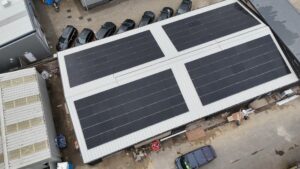
Save Energy UK’s commercial case studies include an installation at the Applewood Hotel in Bournemouth. The system combined 31 Jinko solar panels with a Sunsynk inverter and battery storage. The company reports that the installation is projected to generate 70 per cent of the hotel’s energy from solar, with projected lifetime bill savings of £244,102. These figures relate to that particular project and should not be treated as a typical result for other businesses. Save Energy UK
The example illustrates why a site specific design matters. A hotel’s energy requirements, opening hours and available roof space differ from those of an office, warehouse or school. A business needs a proposal based on its own energy data and premises before it can judge whether a similar approach would suit it.
Even if a business is unsure about installing a battery immediately, it can be useful to discuss storage during the solar design stage. The installer can consider how the system may need to operate if a battery is added later. This includes the inverter, electrical layout, available space and how the system will be monitored.
Planning for possible storage does not mean that a business must buy a battery. It gives the business a clearer understanding of its options and may help avoid decisions that limit future choices. The proposal should explain what is included, what could be added later and how each option affects the expected costs and savings.
Planning requirements may also depend on the building, its location and the proposed work. Businesses should confirm whether any planning permission or other approvals are needed for their particular project before installation.
Save Energy UK designs and installs commercial solar systems for businesses across Dorset and the wider UK. The company says it tailors systems to each site and offers a consultation, bespoke design, technical survey, installation and aftercare. Its commercial experience includes projects for businesses and organisations in sectors such as hospitality, education, agriculture and leisure. Save Energy UK
If you are considering solar panels and battery storage for your business, start by reviewing your electricity data and discussing your plans for the premises. Save Energy UK can assess the site and explain whether a combined system, solar panels alone or a design prepared for future storage is likely to suit your requirements.
Contact Save Energy UK to arrange a commercial solar consultation and request a tailored proposal for your business.
Yes. A business can install solar panels without battery storage and use the electricity as it is generated. Whether adding a battery would improve the business case depends on its energy use, surplus generation and the costs involved.
Not necessarily. Some systems can provide backup power, but this requires suitable equipment and system design. Ask the installer which circuits would remain powered, for how long and under what conditions.
Some battery systems can charge from the grid, depending on the equipment, settings and electricity tariff. Whether this is useful depends on the tariff structure and the business’s energy needs.
Compare proposals for solar panels alone and for solar panels with a battery. Ask the installer to use your energy consumption data and explain the expected generation, battery use, electricity import, export and financial assumptions.